

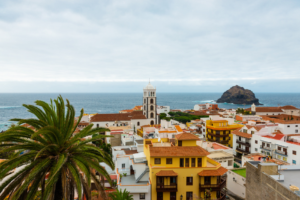
Puerto de la Cruz is much more than beaches and nature. Its streets hold an architectural treasure that tells the story of centuries of tradition, trade and cultural blending. Strolling through its historic centre is like stepping into an open-air museum, where every façade, every balcony and every courtyard speaks of this northern city’s noble past.
The Port’s Architectural Legacy
The traditional Canarian architecture we can admire in Puerto de la Cruz is the result of a fusion of Andalusian and Portuguese influences that arrived with the first settlers after the conquest. The 18th century marked the city’s building peak, when it became the main commercial port of the Orotava Valley, attracting a prosperous merchant bourgeoisie that left its mark in magnificent stately homes.
Unlike other Canarian towns, Puerto de la Cruz preserved its traditional urban layout even when royal bans on the construction of balconies arrived. While Philip II ordered their removal on the mainland for reasons of safety and hygiene, such mandates were ignored here, allowing one of the most distinctive elements of our architecture to flourish.
Distinctive Elements of Puerto’s Architecture
Tea-Wood Balconies: Wooden Jewels
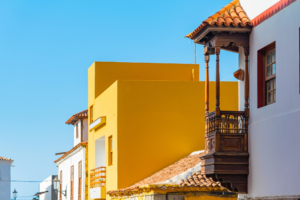
Without a doubt, balconies are the most iconic and recognisable feature of traditional Canarian architecture. These wooden structures that elegantly project from façades not only enhance buildings, but also serve an essential practical purpose: providing shade and ventilation in the islands’ subtropical climate.
Traditionally, the wood used was tea, the resin-rich heartwood of the Canary Island pine. With its characteristic caramel-reddish tone, this wood is virtually incorruptible thanks to its high resin content, which explains why many balconies built centuries ago are still preserved in excellent condition. Its density is such that it sinks in water, and its resistance to the passage of time is legendary.
Canarian balconies feature several distinctive elements:
- Canes: exposed wooden beam ends that project outward and support the structure
- Parapet: divided into two parts, the lower section closed and decorated with carved corbels, and the upper section with a balustrade
- Supports: vertical posts with carved brackets
- Canopy roof: a wooden cover finished with Arab tiles
We find two main types: covered balconies with turned balusters, and latticework balconies, the latter influenced by Arab art. Both types alternate on Puerto’s façades, creating a play of light and shadow that defines the city’s visual character.
Inner Courtyards: The Heart of the Home
The courtyard is the soul of the traditional Canarian house. Inspired by Castilian and Andalusian architecture, these open-to-the-sky spaces function as the home’s central hub, around which all rooms are arranged.
In stately houses, the courtyard is generously sized and surrounded by galleries with wooden balconies that connect the upper-floor rooms. Stone columns support these galleries, while sash windows—another characteristic feature—allow the entry of light and air to be regulated.
The ground floor was traditionally used for commercial purposes or storage (warehouses), while the upper floors housed the family living quarters. The most noble homes included small private chapels, a testament to their owners’ devotion.
Austere Façades, Surprising Interiors
Traditional Canarian architecture is characterised by a certain exterior austerity that contrasts with the richness of its interiors. Façades are usually simple, whitewashed in light colours, with few decorative elements. This sobriety is broken precisely by the wooden balconies, which become the only—yet spectacular—ornamental feature.
Windows are another key element, designed with splayed openings to maximise the entry of light. Beside them are the traditional stone benches, perfect for enjoying the sea breeze while watching the street.
Casa Iriarte: A Landmark of Stately Architecture
If there is one building that exemplifies Puerto’s traditional architecture at its finest, it is the Casa Iriarte. Built in the late 18th century on Calle San Juan, this stately home is considered one of the most representative buildings of Puerto de la Cruz’s “golden century”.
Declared a Site of Cultural Interest, Casa Iriarte features all the characteristic elements of the period’s bourgeois architecture: tea-wood balconies with turned balusters and carved brackets, three-hipped Arab-tile canopy roofs, sash windows with wooden shutters, and a floor plan suggesting a rectangle with two courtyards.
The Iriarte brothers—prominent writers and politicians of Spain’s Enlightenment period—were born in this house. Today, although its use has changed, the building remains an architectural and tourist reference point in the historic centre.
La Ranilla Neighbourhood: Charming Popular Architecture
While the grand mansions are concentrated in the centre, the La Ranilla neighbourhood preserves magnificent examples of Canarian popular architecture. This former fishermen’s quarter, named after the soldier Ruiz Ranilla, the area’s first resident, features a more modest but equally valuable architectural typology.
Single-storey houses predominate here. They are narrow-fronted homes with two or three openings, yet with a long layout stretching inward. The rectangular floor plan is organised around a central or side courtyard, and roofs are covered with Arab tiles.
Built with more humble materials than the stately mansions, these constructions reflect the architecture of the historic port’s working classes. Their simplicity does not diminish their charm: colourful façades, small wooden balconies and the typical wooden crosses beside entrances (decorated with flowers during festivities) create a picturesque atmosphere that transports visitors to another era.
In recent years, the neighbourhood has undergone a remarkable revitalisation, becoming a space where urban art and traditional architecture coexist harmoniously. Interventions from the Puerto Street Art project have enhanced many party walls without altering the original character of the buildings.
Other Unique Architectural Features
Cross Chapels
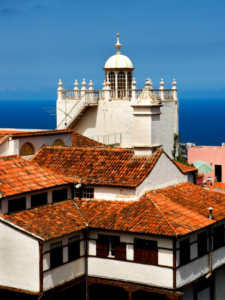
In La Ranilla you’ll find small hermitages with whitewashed façades, built between the 19th and 20th centuries. These chapels, linked to popular devotion, are a characteristic religious feature of Canarian working-class neighbourhoods.
Commercial Houses
From the 17th century onwards, Puerto de la Cruz saw the rise of a distinctive building type: commercial houses with lookout points or tower-like structures on the corners, used to watch for ships arriving at the port. These buildings also incorporated mezzanines with galleries, adapting to the needs of commercial activity.
Estate Gateways and Boundary Walls
Although more typical of rural settings, some properties in Puerto still preserve the characteristic stone gateways with triple crenellation and a central cross, set into crenellated walls that once marked the limits of old estates.
Materials and Construction Techniques
In addition to the famous tea wood for carpentry and balconies, traditional architecture in Puerto uses:
- Canarian stone: used on façade corners, gateways and structural elements
- Lime: for wall rendering, providing the characteristic bright white finish
- Arab tile: for roofs, perfectly suited to the climate
- Stone masonry: for window and door frames in the most noble constructions
Construction techniques are based on load-bearing rubble masonry walls, with tea-wood beams supporting floors and roofs. This combination of materials allows buildings to “breathe”, naturally regulating humidity and temperature.
State of Preservation and Challenges
Puerto de la Cruz’s historic district was declared a Site of Cultural Interest, recognising the importance of preserving this architectural heritage. However, maintaining these buildings presents several challenges.
Many historic buildings require significant investment for restoration. Old tea wood needs specific care, and today the felling of Canary Island pine is strictly controlled for environmental reasons, which means alternative woods such as American pine or iroko must often be used in restorations.
Fortunately, awareness of the value of this heritage is growing. Rehabilitation initiatives in areas such as La Ranilla have shown that it is possible to revitalise historic neighbourhoods while preserving their architectural essence, combining heritage conservation with new cultural and tourist uses.
Visiting Traditional Architecture in Puerto de la Cruz
To fully enjoy this architectural heritage, we recommend:
- Walk through the historic centre: Stroll along San Juan and Quintana streets and around Plaza Concejil to admire the grand stately homes
- La Ranilla route: Explore Mequinez, El Lomo and San Felipe streets to discover popular architecture and urban art
- Visit Casa Iriarte: Although the interior currently houses commercial uses, the façade is accessible and highly photogenic
- Look for the details: Pay attention to balconies, sash windows, half-open courtyards, stone gateways and decorative elements
The best time for this route is in the morning or at sunset, when the light highlights the warm tones of tea wood and the textures of the whitewashed façades.


